

The Myth of the "Good Ol' Days"
The Great Amnesia of the Nostalgia Purists

You’ve probably heard it a thousand times from the “good ol’ days” crowd. They look at a room full of people staring at their smartphones, give a heavy sigh, and start longing for a bygone era. They imagine a time when humanity supposedly possessed infinite patience, deep presence, and a mindful approach to everyday life.
But honestly? That entire premise is built on a bit of historical amnesia.
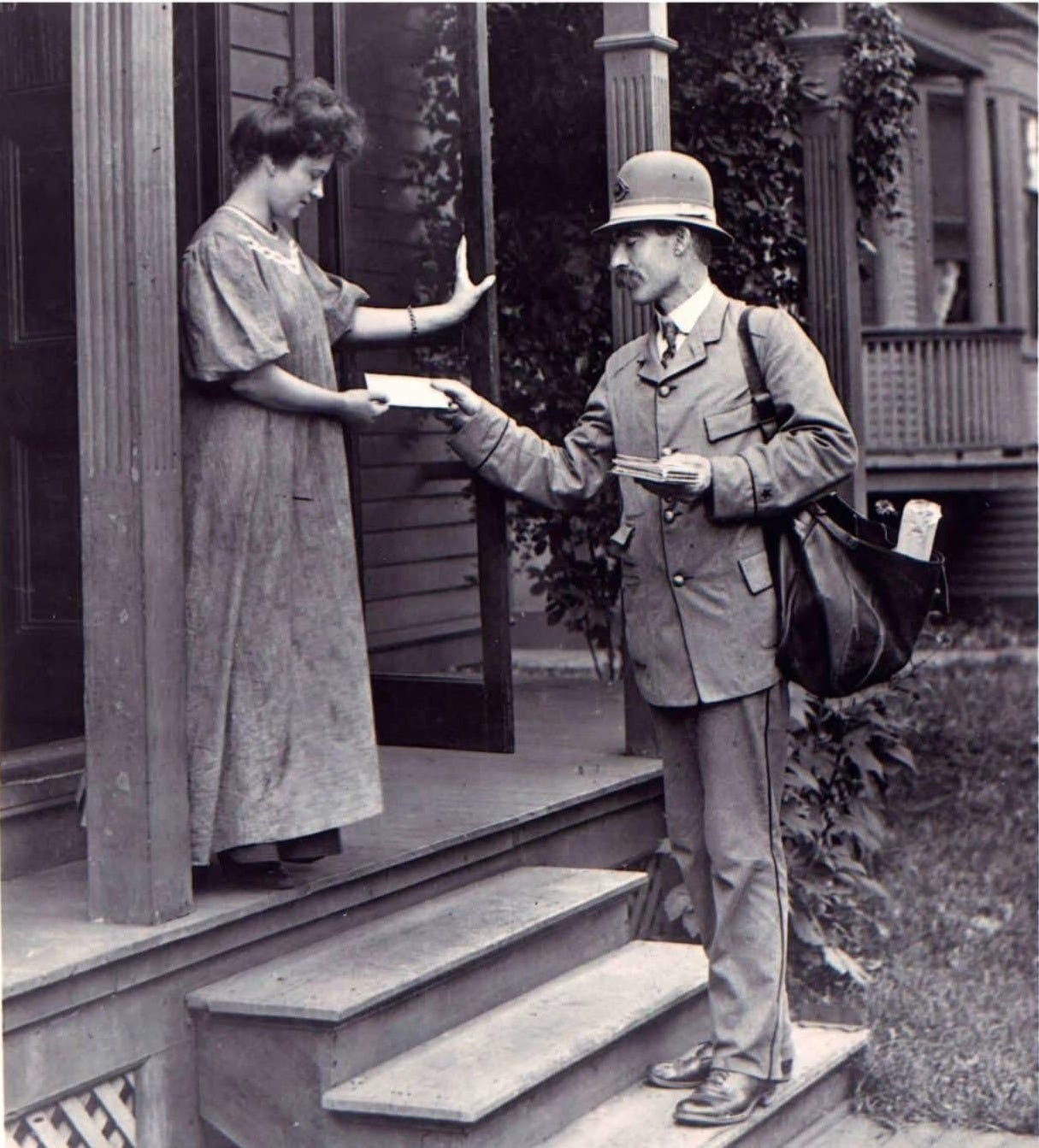
The image above completely dismantles that romantic illusion. The truth isn’t always comfortable for nostalgia purists, but human nature hasn’t actually evolved all that much. We haven’t suddenly become uniquely impatient or hyper connected just because Silicon Valley came along. The truth is, we have always been this way. The only real difference between the 19th century and the 21st century is the delivery vehicle.
The Great Amnesia of the Nostalgia Purists
Right now, there’s a pretty loud cultural debate about how instant communication is ruining our attention spans and breaking the art of human connection. Critics love to claim that text messages and direct messages have made us fragile, demanding, and completely incapable of waiting. Then, they contrast our modern world with the Victorian era—treating it like the absolute gold standard of slow, deliberate living where every letter was crafted like a piece of sacred literature.
It’s a beautiful story, but it’s just not accurate.
When the Uniform Penny Post was established in Victorian London, it didn’t just make sending mail affordable; it accidentally created a high speed, frantic data network. In the heart of the city, mail was delivered up to twelve times a day. Let that sink in for a second. Twelve times a day means the postman was walking up your front steps roughly every single hour. This wasn’t a leisurely postal service. It was a physical, analog version of a fiber optic network. And the moment the Victorians got a taste of that speed, they became just as demanding, impatient, and obsessive as anyone with a smartphone today.
If you strip away the top hats and the glowing screens, the way people behaved across both eras is practically identical. Think about a modern text message versus the Penny Post. Today, you fire off a quick text asking a friend if they’re free for lunch, and you expect a reply within ten minutes. Back in 1880, a Londoner would drop a note into a pillar box at 9:00 AM asking the exact same thing, fully expecting it to land on their friend’s desk by 10:30 AM so they could have a DM style response back by noon.
We also tend to think that the anxiety of being “left on read” is a uniquely modern, digital disease. But Victorians experienced that exact same low grade panic. They would literally pace by their front doors, listening for the heavy click of the brass knocker, getting absolutely furious if the midday delivery was twenty minutes late. In fact, if a letter took more than a few hours to cross town, citizens didn’t just shrug it off—they routinely wrote scathing, venomous letters of complaint to the Postmaster General. So, saying modern tech ruined our patience gets cause and effect completely backward. Technology didn’t create our impatience; our inherent human impatience created the technology.
The Original Social Media Feed
But the postal service wasn’t the only modern convenience hiding in plain sight back then. If the mail was their text messaging, the local newspaper was absolutely their social media platform.
We have a habit of looking back at late 19th and early 20th century newspapers as serious, rigid historical ledgers. In reality, they were the ultimate community bulletin boards. Columns like “Local Happenings” or “County Gossip” functioned exactly like a modern news feed. Reading a line about how someone spent Sunday visiting in the north part of the county, or that a neighbor is suffering from a severe cold this week, is the exact historical equivalent of scrolling through status updates to see who checked in where and who is feeling under the weather. It was public broadcasting for everyday life.
And if the newspaper was the social media feed, emblematic poetry and floral codes were their slang and memes. Back then, people used floriography—the language of flowers—and stylized verses printed on writing paper or postcards to signal inside jokes, flirt, or express a mood without spelling it out directly [cite]. Senders would even tilt postage stamps at very specific angles on an envelope to convey hidden, coded romantic messages—basically an analog emoji. It was a shorthand way of saying, “If you know, you know,” doing the exact same job that internet slang and reaction images do for us today.
Desanitizing the Archives
As family historians and researchers, keeping this perspective in mind is so important because it completely changes how we look at primary records.
Take a look at the artifacts hiding in our own family files. In my collection, I have an old photo postcard from the early 1900s. On the front, there’s a sepia portrait of a young relative standing by a wicker chair. On the back, it’s addressed to Miss Pearl Cox in Salisbury, Missouri, with a quick, scribbled note: “Dear aunt I will send you one of my pictures be sure and dont get Sceard at it...”
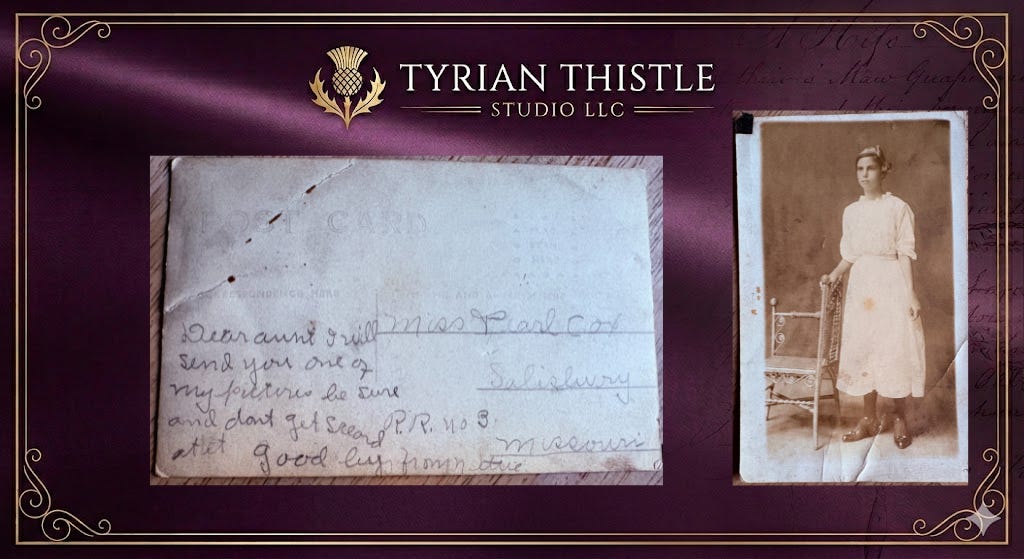
If we look at that through a romanticized lens, we see a precious, rare heirloom to be treated with quiet reverence. But if we stop sanitizing the past and just look at the human behavior behind it, we see the truth: that postcard isn’t a formal piece of historical correspondence. It’s a text message. It is the exact turn of the century equivalent of taking a quick selfie, dropping it into your aunt’s DMs, and typing: “Sending a pic, try not to get scared! LOL! Bye!”
Where Things Diverge
Where these eras actually split isn’t in what we want to say, but in the friction and reach of how we say it. The Victorian and Edwardian systems required an immense amount of physical, human labor to mimic the speed of thought. To send a “text message,” a carrier had to physically walk a route, a steam engine had to choke across a county, and telegraph operators had to manually tap out lines of morse code. Today, that physical friction has basically dropped to zero.
Plus, our ancestors’ hyper connectivity was deeply local. A Londoner could text their neighbor twelve times a day via the post, but a cousin living a few states away remained weeks out of reach. Today, the entire globe has been compressed into a single, inescapable neighborhood.
The Heart Behind the Desk
Yet, despite the massive shift from paper to pixels, the core human driver remains completely identical. We have always been a species desperate to close the gap between ourselves and the people we care about. The relative who paid a penny to rush a photograph to Aunt Pearl was chasing the exact same connection as anyone sending a photo message today.
We didn’t invent impatience, and we definitely didn’t invent the desire to broadcast our daily lives to our communities. We simply perfected the machine that lets us do it faster. When we strip away the nostalgia and look at history clearly, we see that the people of the past weren’t living in a silent, meditative utopia. They were standing at their desks, holding their breath, waiting for the front door knocker to ring.
Sources & Further Reading
The Victorian “Text Message” Network: For a deeper look into the hyper-connected nature of the Uniform Penny Post and how Victorian society reacted to communication delays, see “Victorian ‘text messages’ were delivered 12 times a day” via Big Think.
The Secret Language of Stamps and Correspondence: To explore the hidden codes used on Victorian envelopes, including tilting postage stamps to convey secret romantic meanings, reference “The Victorian’s secret ways of keeping in touch” from The Postal Museum.
Floriography and Coded Messages: For a breakdown of how the language of flowers was used as an historical shorthand for complex social emotions, see “Victorian Era Coded Messages Through Flowers” by Dragonetti Florist.
19th-Century Instant Messaging Analogies: For further historical context comparing 1800s communication speeds to modern messaging habits, see “How Were Text Messages Sent in the 1800s?” published by The Henry Ford Museum.
I publish 3-4 times a week to help you connect with the past and master modern research. Hit the subscribe button to get these editions delivered straight to your inbox:
🏴 Several articles: Personal short stories exploring Scottish heritage and deeply hidden truths in my series, Behind the Desk.
🤖 1 Paid Post: My exclusive, step-by-step Genealogy AI Master Class to help you smash through your family tree brick walls.