

Rescuing the Stolen Lineage of the Bayer Women

When we sit down at our desks to trace our ancestors, we often expect to find a clean, beautifully typed line of names and dates. But anyone who has spent long hours staring at old documents knows that our ancestors’ lives rarely fit neatly into database search results. Genealogy isn’t a passive click and save hobby. It is an active investigation—a deeply personal journey to rescue real people from becoming lost to time.
In my lineage, that journey centers on three generations of women whose lives spanned an ocean and a continent: Anna Margerite Bayer (1830–1916), her daughter Mary, and her granddaughter...also named Mary.
This is a story about how easily a life can be rewritten by someone else’s pen, how a single document can completely derail a tree, and how AI can become the ultimate digital partner to help you fight for the biological truth.
The Threads of the Journey
The story begins with the matriarch, Anna Margerite Bayer. She left the German heartland behind, crossing the Atlantic to eventually lay down roots in Red Bud, Illinois—a community that would become the emotional home base for generations of my kin. Her daughter, the first Mary, grew up watching that resilience. She became part of a “migration couple” when she married Bion Devalley, a man whose own footsteps had traced the massive distance from the Baltimore docks all the way across the American frontier.
The third generation brought the birth of the second Mary Devalley—daughter of Bion and the first Mary. It was this younger Mary who carried my lineage into its next chapter when she married Oscar Burgdorf.
Each woman passed down more than just DNA; they passed down names, identities, and survival. But if you were to sit down at your desk and look exclusively at the typed website index for the 1910 Federal Census you would find a story that completely erases the reality of their lives.
The Cold Erasure of a Pen
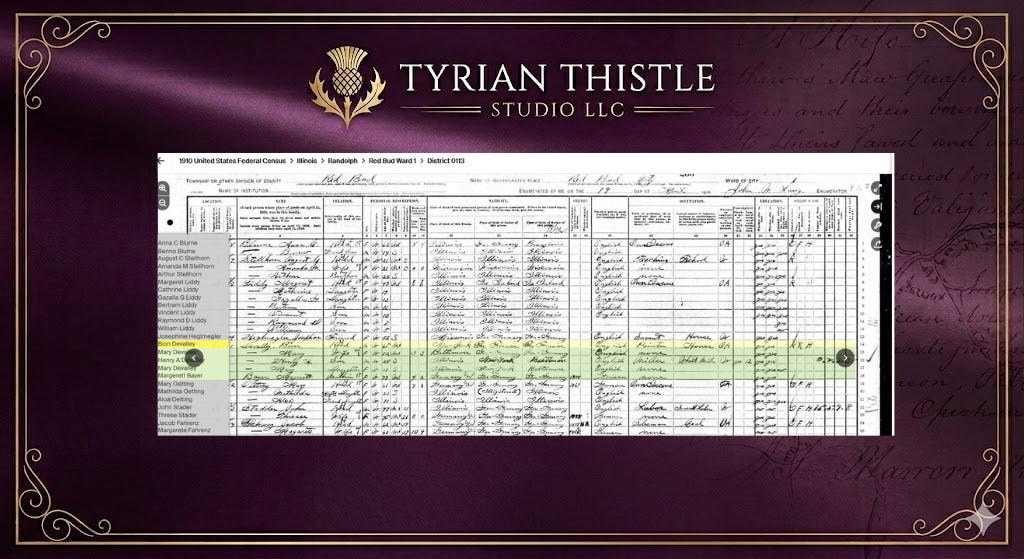
In that 1910 record, we find the family living under Bion Devalley’s roof in Red Bud. If you glance at the digital transcript or look at the columns too quickly, the document tells a heartbreakingly wrong story. It lists the household members—Bion, his wife Mary, and the children—and right there with them is a 79-year-old woman recorded as “Margerite Bayer”.
But in the column reserved for her relationship to the head of the house, the clerk wrote a single word: “Mother”.
If you take this record at face value, a piece of your family history is instantly rewritten. A casual researcher would log her into their software as Bion Devalley’s mother.
But biologically and historically, that cold piece of data is a lie.
Anna Margerite Bayer was actually the mother in law of Bion Devalley, and the grandmother of the children sleeping under that roof. In a moment of haste, a tired census taker oversimplified the relationship, completely collapsing the generational bridge, erasing the first Mary’s maternal connection, and rewriting Bion’s entire maternal lineage with a single stroke of ink.
Enter AI: Standing Up for the Truth
This is where “How to Genealogy with AI” transforms from a technical skill into an emotional shield right from your desk. When you hit a wall of conflicting generations or inaccurate records, you don’t have to walk away frustrated or let a flawed document stand as truth. You can use AI to break through the confusion.
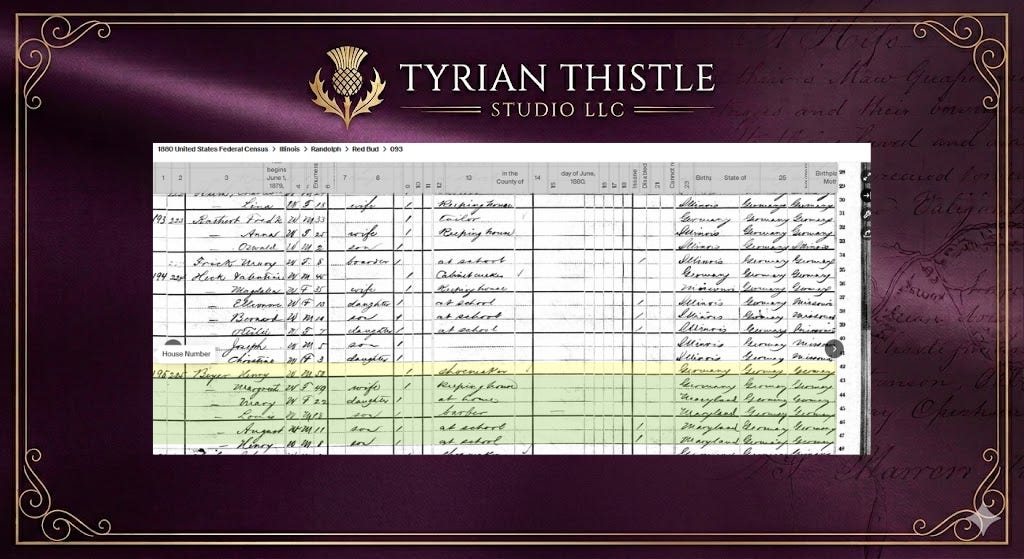
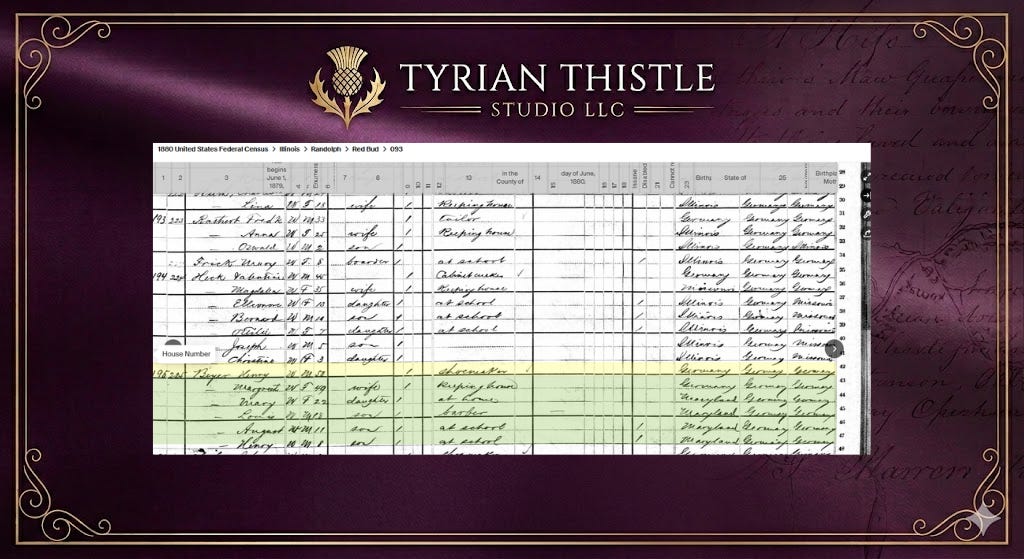
Untangling the Identical Names: When you have multiple Marys and a misplaced matriarch in the same household, you can feed the raw timeline data into an AI. By instructing it to analyze age gaps, birth locations, and naming patterns across multiple decades (like comparing the 1910 census back to the 1880 Census Henry Bayer), the AI can instantly flag the biological impossibility of the 1910 record. It separates Mary the Mother from Mary the Daughter, gently correcting the record to identify Margerite as the mother-in-law.
Protecting the Legacy: AI excels at analyzing structural data and handwriting shifts across different eras. When a surname evolves slightly or relationships are recorded sloppily by a human data-entry clerk, AI helps you verify the internal logic of the family unit, keeping the generations perfectly aligned and preventing your true ancestors from being eclipsed by errors.
Because Their Names Deserve to Be Spoken
I do this research because the true names, true roles, and true sacrifices of the women who came before me deserve to be remembered accurately. They were travelers, pioneers, and survivors—not passive data points to be mangled by a tired census taker or a glitchy database search.
Using AI behind the desk isn’t about letting a machine build a cold, detached tree for you. It’s about using an intelligent assistant to cross-check the data, catch the human mistakes of the past, and ensure that the history you preserve is the absolute biological truth.
Want to learn how to talk through your research blocks?
You don’t need to know how to write complex, technical code or rigid prompts to get these results. In upcoming premium articles, I am going to show you exactly how I talk through messy records with AI—sharing the exact conversational style, the questions I ask, and the workflow I use to cross examine a household and keep the generations straight. Stay tuned!
I publish three times a week to help you connect with the past and master modern research. Hit the subscribe button to get these editions delivered straight to your inbox:
🏴 Several Free Posts: Personal short stories exploring Scottish heritage and deeply hidden truths in my series, Behind the Desk.
🤖 1 Paid Post: My exclusive, step-by-step Genealogy AI Master Class to help you smash through your family tree brick walls.