Bloodlines vs. Borders
Why the World Misunderstands the American Search for Roots

A comment caught my eye on social media the other day, a casual bit of digital gatekeeping aimed at an American exploring their roots: “If you weren’t born in Scotland, then you’re not Scottish.”
I beg to differ. (Clutches pearls).
It is a sentiment born out of a profound misunderstanding of the American melting pot, a rigid, modern worldview that confuses the borders on a map with the blood in our veins. To say an American has no claim to their heritage is like telling the child of two Mexican immigrants that they have no right to claim Mexico simply because they drew their first breath north of the border. It conflates nationality with ethnicity, stubbornly forgetting that a passport tells you where you pay taxes and vote, but your lineage tells you exactly who you are.
My nationality is American. But my ethnic background is Scottish, English, and German.
Those truths do not cancel each other out, they look after one another. To be an American is to belong to a young nation built by those who crossed terrifying oceans, leaving behind everything they had ever known. Because our civic history is brief, we carry a deep, quiet hunger to know the very beginning of our story. We do not look backward across the Atlantic to play act as modern citizens of a foreign land, we look backward to honor the resilience of the people who carried our names, our traits, and our very existence across the water. Our heritage is not a costume, it is the anchor that keeps us grounded in a vast, shifting world.
The Architecture of the Bloodline
To understand why this anchor matters so much, one must understand that we do not view heritage as a commodity with an expiration date. In older, more homogeneous nations, identity is often treated as a geographic default. You are born within the borders, you walk the ancient streets, and your culture is absorbed simply by breathing the air. It is an identity handed to you by your immediate surroundings.
But America was built on an entirely different architecture.
When people left places like Scotland, England, or Germany, they did not step into a cultural vacuum that instantly bleached their history clean. They brought their traditions, their resilience, and their worldviews with them. They planted those seeds deep into American soil. To suggest that a family’s ethnicity vanishes the moment a document is stamped at a port of entry is a remarkably shallow, uneducated view of human history
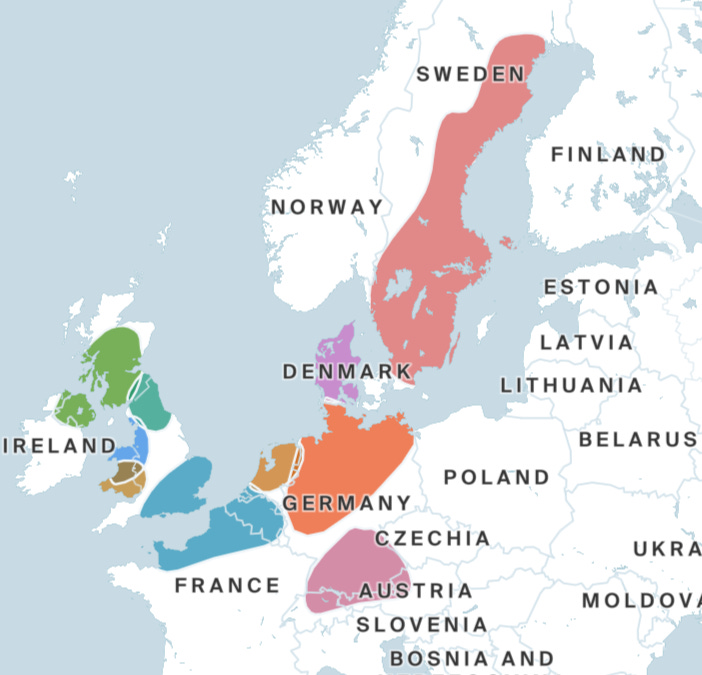
If anyone doubts the reality of this inherited history, they only need to look at the science. Our identity is not just a collection of old stories, it is written directly into our genetic code. My own DNA results map out this exact ancestral journey across Western Europe:
32% Scottish
25% English
38% Western Germany
5% Nordic
We live in a society where where you are from and where you are going have always sat at the same table. In the American melting pot, ingredients do not lose their origin, they blend to create something entirely new, while still retaining the distinct, unmistakable flavor of where they began. To hold a civic allegiance to the Stars and Stripes is our shared privilege, but to deny the ancestral blood that shaped a family’s grit and character is to deny the very raw material that makes us human.
The Gatekeeper’s Blind Spot
Of course, if you say this out loud online, you run right into the digital gatekeeping we see every single day. Let us be honest about the real root of that online noise: it frequently stems from a flat out dislike of Americans, wrapped in a protective elitism over culture. There is a collective eye roll from across the Atlantic whenever an American arrives claiming a historic clan, an ancestral tartan, or a deep continental lineage. To a local living in Edinburgh, London, or Munich, it can feel like their daily, modern reality is being reduced to a superficial tourist costume.
But that negativity creates a massive blind spot. In their eagerness to gatekeep, they completely misinterpret the genuine American search for roots.
They mistake a deep, reverent quest for identity as a shallow exercise in play act behavior. They do not see that for us, discovering our ancestry is not about claiming we live the modern life of a European citizen, it is about honoring the historic line that connects us to the past. By reducing our heritage to a zip code, the gatekeepers ignore the profound human need to know whose shoulders we are standing on, and they completely miss the fact that the ways of life of our ancestors did not die, they transformed.
The Brutal Why
To truly understand this connection, we have to look past the modern map and understand the sheer weight of why they left in the first place. The gatekeepers online talk about Europe as if our ancestors casually walked away for a change of scenery. They did not. They were pushed out by waves of immense, systemic heartbreak across different eras of history.
Long before the United States was even a country on a paper map, my Scottish and English ancestors boarded those crowded, disease ridden wooden ships for a grueling voyage across the Atlantic. In Ulster, the Presbyterian Scots found themselves caught in a vice, squeezed dry by exorbitant rent hikes from rapacious British landlords and subjected to severe religious persecution that banned them from their own local governance. Along the very same roads, the English peasantry was being pushed out by a system of Enclosure Acts that stripped ordinary farming families of their common farmlands, handing the soil over to wealthy land barons and leaving everyday people completely landless and desperate. Fleeing the exact same oppressive economic system, they traveled together because ownership of land was their only shot at survival.
Generations later, in the mid 1800s, the German branches of my tree were forced to make the exact same terrifying choice. They left behind a mainland torn apart by devastating crop failures, economic ruin brought on by the rise of factory manufacturing, and intense political tyranny following the failed democratic revolutions of 1848. Facing forced military conscription and heavy handed government control, entire family groups packed what little they owned. They were drawn across the sea by the glowing writings of travelers like Gottfried Duden, who promised that the rich, open valleys of the American Midwest looked just like their homeland, but offered absolute freedom and independent land.
Our ancestors stepped off those boats into a raw, dangerous, untamed frontier. They brought nothing with them but their grit, their faith, their songs, and a profound, bone deep defiance of tyranny. They cleared the forests, built the homesteads, and poured their blood directly into the mortar of this country. They became the fierce, unyielding backbone of a new world because they refused to let kings, landlords, and modern bureaucrats dictate their lives ever again.
Because the truth is, the search for our roots is not a hobby. It is an act of love, a quiet rebellion against time, and a sacred debt of remembrance.
When you sit in the heavy silence of an archive, or stare into a glowing screen in the dead of night, you are not looking for a trendy label to wear. You are looking for a pulse. You trace your fingers over digital scans of two hundred year old cursive, ink pressed into paper by a clerk whose hand has long since turned to dust, and suddenly, a name leaps off the page. A census record. A ship manifest. A cold, clinical line of text or an illiterate X marking a signature, capturing the exact, terrifying moment a branch of your family fractured itself away from an ancient soil so that you could eventually exist.
That history does not wash away in a generation or two. It lives on in the stubborn grit passed down from mother to daughter. It lives on in the unyielding resilience that pulls us out of bed on our darkest mornings, and the names we whisper into the hair of our sleeping children. We carry the heavy mists of the Scottish hills, the fields of England, the traditions of Germany, and the fierce survival of those who came before us directly in our blood. It is woven into our DNA, a quiet melody playing in our bones whether the rest of the world can hear it or not.
The gatekeepers can keep their maps and their modern border checkpoints. They own the current soil, and they are welcome to it. But they do not own the history, and they do not own the bloodline. To be an American who honors their heritage is to understand a profound, beautiful truth: a tree can grow in new soil, towering toward a sky its ancestors never saw, while still drawing its deepest, fiercest strength from the ancient roots that anchor it across the sea.